Your Financial Aid Letter Arrived and It’s Not Enough. Now What?
If you’re a college-bound student, this is likely the moment you’ve been waiting for — the financial aid offer has finally arrived. You saw the word “Congratulations!” in bold letters, and for a brief, breathless moment, the weight of the last few years simply melted away. You’re in.
But then, you scrolled down to the financial aid package.
You did the math, subtracted the grants from the total tuition, and felt your heart sink. The “gap”; the amount your family is expected to pay out of pocket is far larger than you had anticipated. And just like that, your dream school begins to feel like an unaffordable reality.
If you are staring at a financial aid letter that feels like a “soft rejection” because of the price tag, take a deep breath. This isn’t the end of the road. It is the beginning of a negotiation. Here is exactly what you need to do next.
Don’t Panic: First, Understand Your Real Net Price
Before assuming that college is beyond your financial reach, it is essential to distinguish between the sticker price and the net price.
- Sticker Price: The total cost of attendance, including tuition, room and board, books, and fees, as published on the institution’s website.
- Net Price: The amount you will actually pay after subtracting scholarships and grants, which are forms of aid that do not require repayment.
When evaluating your options, calculate your true out-of-pocket cost across all four years, not just the first. It is also important to note that loans should never be counted as financial aid, since unlike grants and scholarships, every dollar borrowed must eventually be repaid.
A Fresh Academic Start for Smarter SAT Preparation
January marks the start of a new academic term, and students return from winter break mentally refreshed, and more open to building new habits. This creates an ideal environment for introducing a structured SAT study routine before academic demands begin to intensify in the spring.
By starting early, students can integrate SAT preparation into their weekly schedule in a balanced and sustainable way. Instead of scrambling to fit test prep into an already overloaded spring calendar filled with exams, projects, and extracurriculars, January allows SAT study to become part of the routine from the start. This leads to better consistency, less stress, and far more effective long-term preparation.
Understanding Why Your Financial Aid Offer Falls Short
To fix the problem, you need to understand the cause. Generally, aid letters fall short for one of three reasons:
- The FAFSA/CSS Profile Error: Did you accidentally report your home equity incorrectly? Did you miss a digit on your parents’ income? Small clerical errors can lead to massive losses in aid.
- Changed Circumstances: The financial aid forms look at “prior-prior” year tax data. If your family has faced a job loss, high medical bills, or a death in the family since you filed, the college is basing your aid on a financial reality that no longer exists.
The Financial Aid Appeal: What It Is and Why It Matters
Most students believe that the financial aid award is final. It is not. Colleges have a process called Professional Judgment (PJ). Financial aid officers are human beings who have the authority to adjust your financial data if you can provide a documented reason. This isn’t “begging” for money; it’s providing the university with a more accurate picture of your financial needs.
Beyond cases of financial hardship, there is another compelling reason to consider an appeal. If a peer institution, a college of comparable ranking and academic prestige has offered you a significantly stronger merit scholarship, you may have grounds to request that your preferred school match or come closer to that offer. Colleges actively compete for high-achieving students, and many have the flexibility to revisit their initial offer when presented with a credible competing package.
How to Strengthen Your Appeal with the Right Documentation
You cannot simply tell a college, “I want more money.” You must substantiate it with clear, documented evidence that justifies a reassessment of your package.
- For Need-Based Appeals: Gather relevant supporting documents such as layoff notices, medical invoices, or proof of a sibling’s concurrent enrollment in a private institution. Any documentation that reflects a significant change in your family’s financial circumstances will strengthen your case.
- For Merit-Based Appeals: Compile your acceptance letters and competing scholarship offers from peer institutions. These documents serve as concrete leverage, demonstrating that other colleges of comparable standing have recognized and rewarded your academic achievements more generously.
How to Write the Perfect Appeal Letter (Without the Stress)
Appealing to a Financial Aid Officer requires a delicate balance: you must be respectful yet assertive, grateful yet direct, and clear-headed when presenting the financial details that make your case.
This is where Top5 Colleges can change the game for you.
We believe that no student should have to turn down their top-choice college simply because they didn’t know how to ask for help. We’ve built a tool specifically designed to bridge the gap between your dream college and your budget.
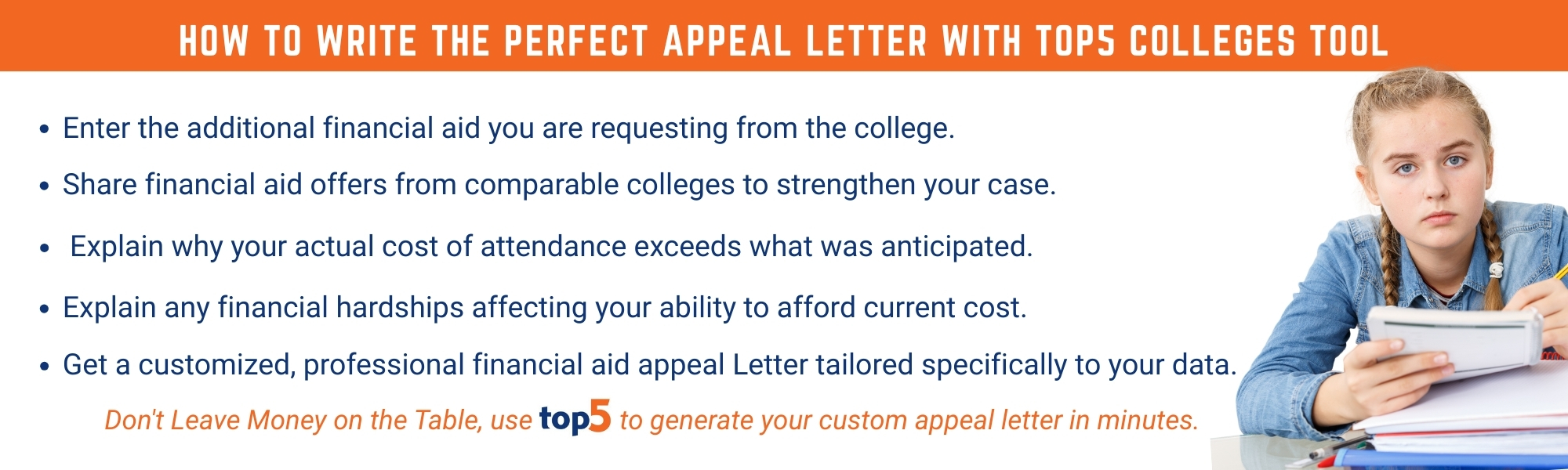
Here’s how it works:
- Expected Aid Amount: Enter the additional financial aid you are requesting from the college.
- Competing Offers from Peer Institutions: Provide the financial aid offers you have received from comparable colleges; these strengthen your case significantly.
- Reason for Higher-Than-Expected Costs: Explain why your actual cost of attendance exceeds what was anticipated — for example, travel distance, housing, or other personal circumstances.
- Current Financial Challenges: Describe any financial hardships that make it difficult to afford attendance, such as a change in family income, medical expenses, or other pressing obligations.
The Result?
Our platform generates a customized, professional Financial Aid Appeal Letter tailored specifically to your data. You don’t have to worry about the formatting or the “right” words to say. You’ll receive a polished document that you can forward directly to the financial aid office of your respective college.
Don't Leave Money on the Table
The “sticker price” is just a starting point. If your financial aid letter isn’t enough, don’t walk away from your future. Use the Top5 Colleges tool today to advocate for the aid you deserve and turn that “maybe” into a “yes.”
Visit Top5 Colleges now and generate your custom appeal letter in minutes.