Still Waiting for Award Letters? How Families Can Plan College Costs Now

Still Waiting for Award Letters How Families Can Plan College Costs

Still Waiting for Award Letters? How Families Can Plan College Costs Now

It is that time of year when many families are anxiously waiting for financial aid award letters from colleges. While students look forward to their acceptance letters, the true milestone for many parents is the arrival of the financial aid package. This waiting period can be incredibly stressful. Without clear numbers, it becomes difficult to compare options, assess true affordability, or feel confident about committing to college. As decision deadlines approach, the lack of financial clarity often leaves families feeling uncertain. 

While award letters are important, waiting for them does not mean families cannot explore college’s affordability. With the right approach and access to data, it is possible to plan college costs now and avoid rushed, high-risk decisions later. 

To learn how you can gain clarity on college costs, keep reading this blog. 

Why Financial Aid Delays Create Uncertainty

Financial aid timelines vary widely across institutions. Some colleges release award letters early, while others take weeks or even months longer. When students apply to multiple colleges, this staggered timing makes it nearly impossible to compare offers side by side. 

Adding to the confusion, award letters are not standardized. Colleges present grants, scholarships, loans, and work-study in different formats. What looks generous at first glance may result in a high percentage of loans, leaving families unclear about the true out-of-pocket cost. 

As a result, many families default to using published tuition prices, which rarely reflect what they will actually pay. 

How Sticker Price Can be Misleading

The posted tuition, or “sticker price,” of a college is one of the most misleading figures in higher education. The sticker price typically represents the published, full cost of attending a college before any financial aid is applied. What families actually pay is the net price, which is calculated after deducting grants, scholarships, and institutional aid. 

Two colleges with similar tuition can differ significantly in net cost once housing, fees, and financial aid are considered. Without focusing on net price, families risk eliminating affordable options or committing to college that exceed their budget. 

How Families Can Plan Before Award Letters Arrive

Even if award letters have not yet been received, families can take proactive steps to evaluate affordability: 

  • Compare total cost of attendance, not just tuition 
  • Review historical financial aid trends across institutions 
  • Estimate likely out-of-pocket expenses 
  • Identify colleges that consistently offer strong institutional aid 

This approach allows families to narrow their choices to colleges that are both academically and financially realistic. When award letters do arrive, decisions become confirmation-driven rather than reactive. 

How Comparing College Costs Side by Side Helps

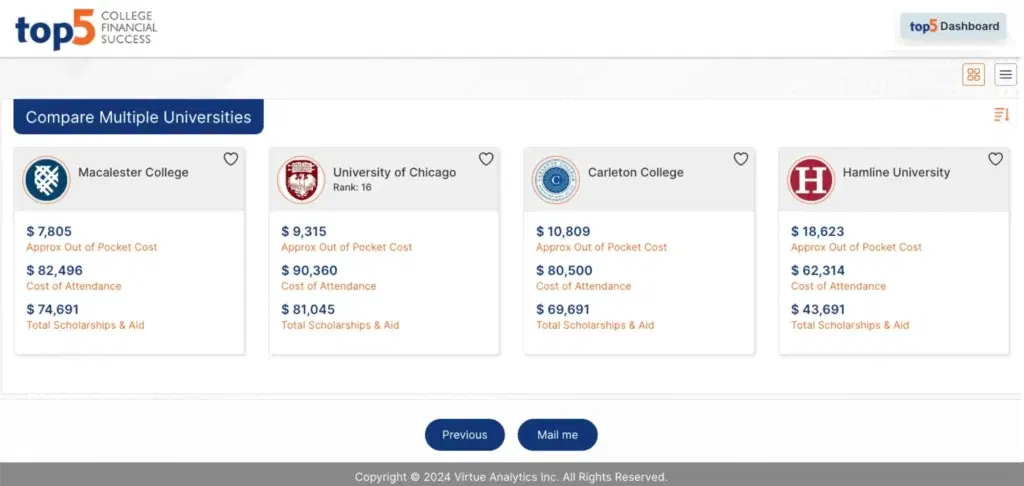
One of the biggest challenges for families is comparing multiple aspects of college costs side by side, such as the cost of attendance, financial aid, scholarships offered, and out-of-pocket expenses. Without a centralized view, this process often relies on spreadsheets, guesswork, and incomplete data. 

A clear, side-by-side comparison of college costs helps families quickly identify which options align best with their financial situation. It also reveals cases where a lower-tuition college may ultimately cost more out of pocket than a higher-priced institution that offers greater financial aid. This level of clarity is especially valuable during periods of uncertainty. 

How Top5Colleges Can Bring Cost Clarity to the Families

Top5Colleges can help families plan proactively by enabling comparisons across thousands of colleges on a single platform. Instead of waiting for every award letter to arrive, families can evaluate estimated out-of-pocket costs and affordability early in the decision cycle. 

With Top5Colleges, families can: 

  • Compare colleges based on estimated net cost 
  • Identify financially realistic options faster 
  • Reduce uncertainty while waiting for official aid letters 

This data-driven approach empowers families to make informed decisions, even when timelines are unpredictable. 

Conclusion

Waiting for financial aid award letters is a normal part of the college admissions process. However, this waiting period does not have to be unproductive. With Top5 Colleges, families can use this time to plan more effectively by estimating the net price of different colleges and understanding potential out-of-pocket costs in advance. 

The most confident college decisions are made with clarity, not last-minute pressure. Early planning allows families to compare options realistically, set expectations, and avoid rushed financial decisions once award letters arrive. By preparing now, families are better positioned to make informed choices when it matters most. 

Get Started For Free